
Last month, we published a deep dive that laid it all out: Navigating the Automation Jungle in 2026 – From Rule-Based Bots to Goal-Driven AI Agents, which highlighted the technological leaps in the field of enterprise automation.
In this blog, we’re zooming in on the #1 use case often requested by our clients: Project Support Agents — specialized AI-driven solution that help Project Managers deliver outcomes with more clarity, consistency, and control.
Before we dive into the solution, let’s do a quick pulse check on challenges many teams face today. Do any of these sound familiar in your department or organisation?
- The “Surprise” Cascade: Last-minute change requests or timeline shifts due to internal misalignments that cascade into budget overruns and delayed launches.
- The “Hidden” Landmines: Critical risks or dependencies stay hidden in group chats, emails, and spreadsheets until they blow up.
- The Handoff Fumble: Unclear hand-offs between departments (e.g., R&D → manufacturing, underwriting → claims, marketing → legal) create delays and rework.
- The Mentorship Void: Training and onboarding take forever because the senior team is too busy fire-fighting to guide new hires.
- The Burnout Cycle: Key people burning out from constant “code-red” situations and context-switching.
- The Pursuit of Trackers: Getting accurate information from your team members and externals requires heavy manual intervention, and creating a cycle of follow-ups.
- The Infinite Loop: Responsibilities that float from meeting to meeting without an owner—never solved, but never going away. These are not just orphan tasks, but recurring bottlenecks.

These struggles aren’t just anecdotal frustrations; they are symptoms of a systemic reliance on manual processes that simply cannot scale. We are effectively paying senior managers and decision makers to operate at peak performance, while chaining them down with repetitive admin-work, status chasing, spreadsheet filling, and task management. The financial impact of this inefficiency is quantifiable, substantial, and creates a drag on performance that the industry—and your budget—can no longer ignore.
- According to recent industry surveys, 42% of project managers spend at least one full day every week just manually collating reports. That is 20% of your leadership salary budget effectively spent on data entry.
- It is not just about time; it is about outcome. McKinsey research highlights that large IT projects run 45% over budget and deliver 56% less value than predicted. Why? Because humans are bad at predicting complex risks in real-time.
- This isn’t a trend you can wait out. Gartner predicts that by 2030, 80% of project management tasks (like data collection, tracking, and reporting) will be run by AI. The question isn’t if you will switch, but whether you will do it before your competitors do.
What are Project Support Agents?
AgamX has recently implemented an Agentic AI solution to help project managers navigate through complex unstructured project environments and automate the routine PSO or PMO activities at scale. Especially useful in large programs — these AI teammates that save 30–50% of the administrative load in project management — tracking updates, managing follow-ups, updating Jira tickets, and aggregating data in spreadsheets for that Friday report!
Traditional project automation is linear: If X happens, do Y. AI Agents are dynamic. They perceive, reason, and act. They function less like tools and more like junior analysts or project support office embedded in your team.
In the real-world, this could mean –
- Better coverage and up-to-date view of project risks collated from multiple stakeholders and subject matter experts
- Better alignment and usage of work management tool like Jira, Monday and Asana
- Better quality of bid management while responding to those high-pressure largescale proposals
The possibilities for Project Support Agents are practically limitless…
Our Pilot – Risk Assessment Agent:
We recently implemented a project support agent for an early-adopter, specifically to orchestrate Risk Assessments for large projects. The results were immediate; up to 50% reduction in administrative and communication workload. The Agents proved exceptional at handling tactical communications and risk tracking at scale, even running the whole exercise across weeks and months, until completion.
Key Features:
- Persistent: The “AI teammate” stays online until the progress, risks and mitigation steps are captured from ALL the primary and secondary owners, and is ready for management review
- Long-term Context Memory: The agent remembers and responds to unavailabilities of project members, individual communication preferences (e.g., Email vs. Teams vs. Slack), and context-based follow-ups
- NO new UIs or chatbots: The technology and orchestration is practically invisible for the end users. Agent interacts with project members through standard enterprise tools – Office 365, Outlook, Teams, Sharepoint, Google Workspace, JIRA, Monday, Asana
- Human-in-the-Loop: Project manager is notified via multiple channels where an approval or manual intervention is required.From kick-off meetings to escalation calls, the agent follows the project guidelines.
- Reliability and Safety: Optimal performance is assured through continuous testing, observability tools. Guardrails in place, to ensure that the agent adheres to organisational code of conduct, security policies, as well as regulatory guidelines from GDPR, NIS2 and EU AI Act .
See it in action:
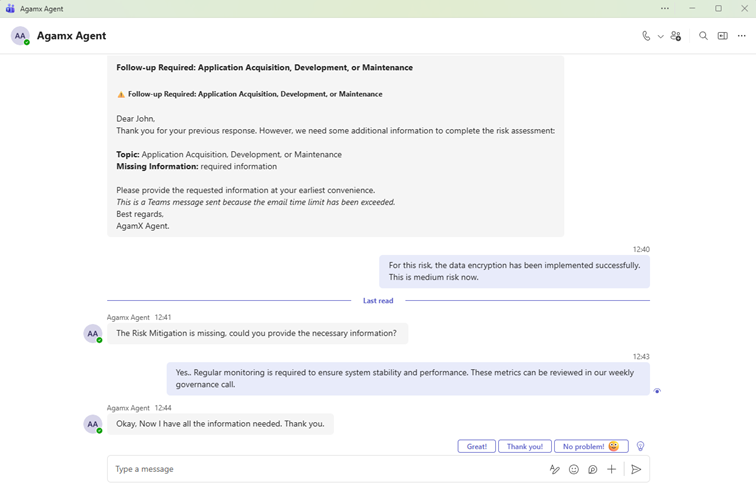
Image Description: Operational view that highlights – Agent following-up with a risk owner (human SME) regarding a missing or unclear information. Suggested Action: To respond via Teams, so that the Agent can update the Excel spreadsheets and JIRA tickets appropriately
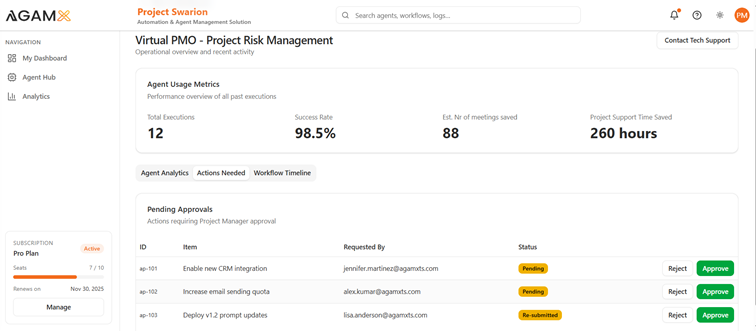
Image Description: Dashboard view that highlights – Risk Assessment Status Summary and the “Action Needed” list that requires manual intervention or approval from Project Manager
Ready to Modernise Your Project Management?
By 2030, the world’s best project managers are the ones that can best orchestrate with Support Agents. They spend more time on actively resolving issues and conflicts, while Agents focus in actively funnelling operational data, tactical communications and flagging early-warnings.
Explore how Project Support Agents can empower your management layer..
- Click Here to Take Our “AI Readiness Self-Assessment“ – Find out if your organisation is ready for Agentic AI.
- Prefer to see the DEMO and talk to us? Contact Us Directly to book a consultation on deploying your first Project Support AI Agent.
Looking forward to hearing from you. 🚀